Why Were Talking Heads So Innovative? How They Reinvented Rock
Updated: Sep 19
by Dave Anthony, Host
Garage to Stadiums Music History podcast
Drawing on the art-school backgrounds of David Byrne, Tina Weymouth and Chris Frantz, the band replaced conventional rock swagger with nervous rhythms, angular guitars, fragmented lyrics and tightly controlled performances.
Their music combined punk, new wave, funk, Afrobeat, minimalism and electronic experimentation without settling permanently into any one genre.

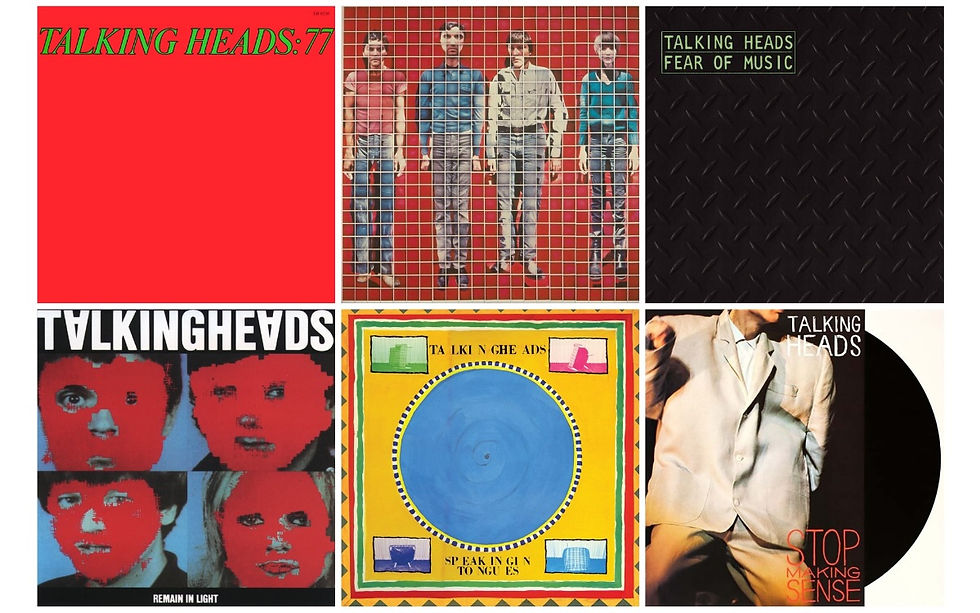
The band’s collaboration with producer Brian Eno pushed that approach further. Instead of merely recording songs as live performances, Talking Heads used repetition, interlocking rhythms, studio manipulation and layered musical fragments to construct them piece by piece. Albums including Fear of Music and Remain in Light presented rock as a system of interacting sounds, what could be described as a new "operating system" for rock music.
Jonathan Gould, author of Burning Down the House: Talking Heads and the New York Scene That Transformed Rock, joined host Dave Anthony on the Garage to Stadiums Music History podcast to examine how three art-school students entered New York’s collapsing downtown scene and helped create a new musical language. His research provides the foundation for understanding how CBGB, Brian Eno, internal tensions and the band members’ contrasting personalities shaped one of rock’s most original groups.
EXPLORE GARAGE TO STADIUMS
Follow the podcast
Follow GTS on Apple, Spotify and YouTube
Follow our social channels
Incredible rock history facts straight to your feed on our various social channels. Instagram, YouTube, X and more.
EXPLORE MORE TALKING HEADS
Read the episode transcript
See the full Story of Talking Heads episode transcript
Listen to our Talking Heads playlist
Stream our curated playlist on Apple or Spotify OR use the playlist at the bottom of the article
How Did Art School Shape Talking Heads’ Music?
Talking Heads approached music with the habits of visual artists. David Byrne, Chris Frantz and Tina Weymouth met through the Rhode Island School of Design community, where experimentation, conceptual thinking and the dismantling of familiar forms were central to their education. Although Byrne left RISD, that art-school environment helped shape the band’s belief that rock conventions could be examined, rearranged and redesigned.

When the trio moved to New York, they did not simply reproduce the raw sound of the emerging CBGB scene. They brought discipline, rehearsal and a conceptual approach that distinguished them from neighbouring bands. Their awkward presentation, stripped-down clothing and tightly controlled music were not conventional rock theatre; they represented a different theory of how a band could look, move and communicate.
What Made David Byrne’s Lyrics and Performance Different?
One reason Talking Heads were so innovative was David Byrne’s rejection of the conventional rock frontman. Although Byrne stood at the centre of the band, even calling him the “centre” is slightly misleading.
Most rock frontmen projected an identity outward. Byrne often appeared to be studying identity in real time. His lyrics resembled the disconnected thoughts that careen through the mind throughout the day.
The frontman as observer, not confessor
Byrne’s physical performance style was tense, angular and deliberately awkward. It did not resemble traditional rock charisma. He appeared more like someone testing how human behaviour functioned under observation.
Jonathan Gould explained that this awkwardness was central to Byrne’s appeal during Talking Heads’ early CBGB performances. Byrne looked nervous and withdrawn, but the band itself was unusually polished because its members had rehearsed intensively. That contrast between apparent discomfort and musical control made it difficult for audiences to look away.
Rather than disguising his unease behind familiar rock-star gestures, Byrne turned it into a distinctive form of performance. His awkwardness was not something audiences had to overlook; it became one of the qualities that attracted them.
Lyrics as cultural data, not confession
Byrne’s lyrics followed the same logic. Instead of relying on confessional storytelling, he assembled songs from fragments of contemporary culture: overheard conversations, consumer slogans, broken internal monologues, religious preaching and media noise. He translated these disconnected signals into rhythm.
“Life During Wartime,” from Fear of Music, places Byrne inside the anxious mind of a guerrilla moving through an imagined future metropolis. The narrator recites hiding places, weapons caches and details of potential violence, but the song never resolves into a conventional story. It reproduces a state of fear, preparation and information overload.
This was not autobiography in the traditional singer-songwriter sense. Byrne behaved less like a confessor than an observer processing the language and behaviour surrounding him.
In operating-system terms, Byrne was not the program. He was a process running inside a larger system, receiving and interpreting inputs rather than asserting a stable identity. That perspective helped Talking Heads turn the anxieties of modern life into both lyrical subject matter and musical structure.
How Did Brian Eno Transform Talking Heads’ Sound?
Brian Eno help transformed Talking Heads’ sound by encouraging the band to treat the recording studio as a creative instrument rather than simply a place to document live performances. His approach to texture, repetition and studio manipulation helped Talking Heads expand their tightly controlled early sound into something more layered, rhythmic and structurally adventurous.

From Roxy Music to ambient thinking
The shift began when Talking Heads encountered Brian Eno. By that point, Eno had moved beyond his early role in Roxy Music, where he helped define the band’s art-glam identity through synthesizers and studio experimentation.
After leaving the group, Eno pioneered ambient music not simply as background sound, but as a radical concept. Music could function as an environment. Sound could be shaped by texture and tone rather than melody and narrative. Music could exist in space as much as it commanded attention.

These ideas made Eno particularly compatible with Talking Heads. Like the band, he approached music as a system that could be examined, redesigned and governed by unconventional rules.
Brian Eno, David Bowie and the studio as a construction space
Eno’s collaborations with David Bowie on albums including Low helped redefine what a record could be. The studio was no longer simply capturing a band performing completed songs.

It became a construction space where tracks could be assembled from fragments, loops, atmospheric layers and modular structures. Structure itself became flexible. Songs became environments. Performance became architecture. Studio production became composition.
This became the prototype for Eno’s work with Talking Heads. By the time he met the band, he was no longer functioning as a traditional producer. He understood how to design the rules under which a musical system could operate.
From recording songs to designing systems
When Eno began working with Talking Heads on More Songs About Buildings and Food, the transformation became structural. The band did not abandon songwriting; it began reconfiguring songs into interacting components.
Nearly every sound could be adjusted, processed or repositioned. Bass, drums, guitar, keyboards and vocals no longer had to perform only their conventional rock functions. Rhythm could move to the foreground, while fragments of melody and language could be layered around it.
The collaboration grew more ambitious on Fear of Music and reached its fullest expression on Remain in Light. If traditional rock functioned as a storytelling engine, Eno’s work with Talking Heads helped install a different operating system beneath it. Once that system was running, everything changed.
How Did Remain in Light Reinvent Rock Music?
Remain in Light reinvented rock music by building songs from repeated rhythmic patterns, interlocking instrumental parts and studio-constructed layers rather than conventional chord progressions and linear narratives. The 1980 album represented the fullest expression of the new musical system Talking Heads had developed with Brian Eno.
How the system worked
The band did not abandon songwriting. It reconfigured songwriting into interacting modules.
Rhythm became the core processing layer. Repetition functioned like memory. Studio loops behaved like background processes. Vocal fragments became the user interface. Melody became an application layer rather than the central organizing force.
Songs were no longer required to operate as linear narratives. They became systems that generated movement, tension and behaviour through the interaction of their individual parts.
“Listening Wind” provides an example of how repetition could create an almost trance-like state. Individual patterns continued cycling while subtle changes in instrumentation, texture and intensity altered the listener’s experience of the whole.

When rhythm became the lead function
One of Talking Heads’ most radical changes was the inversion of rock’s traditional hierarchy. In most rock music, rhythm supports melody. In the band’s Eno-era work, rhythm increasingly became the primary function running the entire structure.
Groove was no longer accompaniment. Groove became infrastructure. Bass, drums, guitar, keyboards and vocals could all operate rhythmically. Instead of one instrument leading while the others supplied support, several parts repeated simultaneously and interacted with one another.
Remain in Light: pop music as a living system
On Remain in Light, this approach became fully explicit. Polyrhythmic structures influenced by Afrobeat interacted with looping processes, interlocking guitar figures, layered percussion and constantly evolving bass patterns.
The result felt dense, circular and self-sustaining. Tracks including “Born Under Punches,” “Crosseyed and Painless” and “Houses in Motion” created movement through repetition and accumulation rather than conventional chord changes.
In “Once in a Lifetime,” Byrne’s performance no longer functioned like traditional storytelling. It behaved more like a looping thought moving through a system that continuously reset itself. The central question “How did I get here?”. The song never resolved. It cycled. The system continued running, and the listener existed inside it.
That combination of conceptual structure and physical rhythm explains why Remain in Light remains so influential. Talking Heads created intellectually ambitious music that could still function as dance music. It was complex enough to analyze, but immediate enough to experience through the body.
How Did Talking Heads Change the Structure of Rock Music?

Talking Heads changed rock music by extending the structural experiments of Remain in Light into a broader way of representing modern consciousness. Their songs did not merely describe fragmentation, repetition and information overload. They recreated those conditions musically.
From narrative to environment
At this stage, Talking Heads were no longer simply writing songs about modern life. They were simulating its structure.

Tracks including “Crosseyed and Painless,” “Houses in Motion” and “Once in a Lifetime” did not function like traditional narratives. They behaved more like models of modern consciousness: fragmented, repetitive, overloaded and self-referencing.
The music derived much of its power from physical repetition, rhythmic layering and interacting systems. The songs felt less like direct expressions of emotion and more like environments the listener entered.
Byrne’s narrators often appeared trapped inside those environments. They absorbed slogans, routines, religious language and social expectations without fully understanding how those influences had shaped their identities. The structure of the music reinforced that uncertainty by circling around questions instead of resolving them.
Architecture versus operating system
There was still architecture in Talking Heads’ music. The arrangements were carefully constructed, the production choices were precise and the instrumental parts interlocked with enormous discipline. But architecture alone does not fully describe what the band was doing.
Architecture describes the structure of a building. An operating system describes what happens inside it: how information moves, how processes interact and how the entire system functions in real time.
Talking Heads became increasingly interested not only in constructing songs but also in simulating the systems of modern life. Rhythm supplied the underlying process, repetition created continuity, lyrical fragments introduced information and Byrne’s performance showed an individual attempting to navigate the resulting environment.
The “operating system” is therefore not meant as a literal technological claim. It is a way of explaining the band’s larger innovation: Talking Heads designed songs that seemed to process behaviour, language and information while the listener was inside them.
Why Do Talking Heads Still Sound Modern?
Talking Heads still sound modern because the underlying logic of their music resembles the way contemporary life now functions. Their songs are built from repetition, fragmented information, overlapping voices and systems that continue operating even when the individual inside them feels uncertain or disconnected.
The technologies surrounding listeners have changed, but the psychological experience captured by the band has become even more recognizable.
The logic of contemporary life
We increasingly live inside systems shaped by feeds, loops, interfaces and continuous streams of information rather than traditional linear narratives.
Talking Heads did not predict modern technology in a literal sense. What they captured was the psychological and structural logic behind it. Through rhythm, repetition, layered systems and fragmented communication, their music mirrored the experience of contemporary life long before the digital age fully arrived.
Byrne’s narrators often seemed overwhelmed by messages, routines and identities they had inherited without consciously choosing. That experience now feels familiar in a culture organized around algorithms, advertising, social media and an uninterrupted flow of information.
How Talking Heads influenced later artists
Talking Heads helped shape modern popular music by showing that intellectual ideas, dance rhythms, experimental production and accessible songwriting could coexist. Guest Jonathan Gould identified R.E.M., Radiohead and Vampire Weekend among the groups that followed paths opened by the band.
Their influence extended beyond any one recognizable sound. Byrne’s fragmented lyrical approach offered an alternative to straightforward storytelling. The band’s rhythmic experiments demonstrated that rock musicians could engage with funk, African popular music and electronic production without remaining confined to traditional rock structures.
Talking Heads also provided a model for artists who treated visual presentation, stage design and recorded music as parts of one larger concept. Their influence can therefore be heard not only in particular guitar tones or rhythms but also in the freedom later musicians felt to redesign what a rock band could be.
Innovation without conventional virtuosity
Gould also identified a less obvious part of the band’s legacy. Many historically important rock groups were built around conspicuous instrumental virtuosity. Talking Heads were not.
Their innovation came from arrangement, restraint and the interaction among parts. Tina Weymouth’s bass lines, Chris Frantz’s rhythms, Jerry Harrison’s instrumental versatility and Byrne’s unconventional guitar and vocal ideas mattered because of how they functioned together.
That may be Talking Heads’ most enduring lesson. A band did not need to play faster, louder or more elaborately than everyone else to transform music. It could instead reconsider the rules, redesign the system and create a new blueprint for what rock could become.
Stream our curated Talking Heads playlist:
© 2026 Garage To Stadiums Podcast