Paul McCartney vs. John Lennon: The Post-Beatles Cold War Explained
Updated: Sep 20
by Scott Campbell
Program Director, Garage to Stadiums music history podcast
Why did Paul McCartney and John Lennon fall out? The Beatles’ creative partnership was overtaken by business disagreements, competing management plans and growing personal mistrust.
Beatles historian and music critic Allan Kozinn joined Garage to Stadiums host Dave Anthony to examine McCartney’s post-Beatles career and his turbulent relationship with Lennon. Kozinn, a longtime New York Times critic who has also written for The Wall Street Journal, co-authored The McCartney Legacy series with Adrian Sinclair. Drawing on their extensive research, this article explores how the Lennon-McCartney partnership fractured, why their conflict spilled into their music and how the two eventually reconciled.
EXPLORE GARAGE TO STADIUMS
Follow the podcast
Follow GTS on Apple, Spotify and YouTube
Follow our social channels
Incredible rock history facts straight to your feed on our various social channels. Instagram, YouTube, X and more.
EXPLORE MORE Paul McCartney
Read the episode transcript
See the full Story of Paul McCartney episode transcript
Listen to our Paul McCartney playlist
Download our curated playlist of Paul McCartney on Apple or Spotify

When The Beatles broke up in 1970, it marked the end of one of the most influential songwriting partnerships in modern music history. What followed between Paul McCartney and John Lennon was not a prolonged feud, but a concentrated burst of tension, legal conflict, and musical retaliation in the early 1970s. This “post-Beatles cold war” peaked between 1971 and 1972, eventually gave way to a genuine personal reconnection later in the decade.
Why did Paul McCartney and John Lennon fall out?
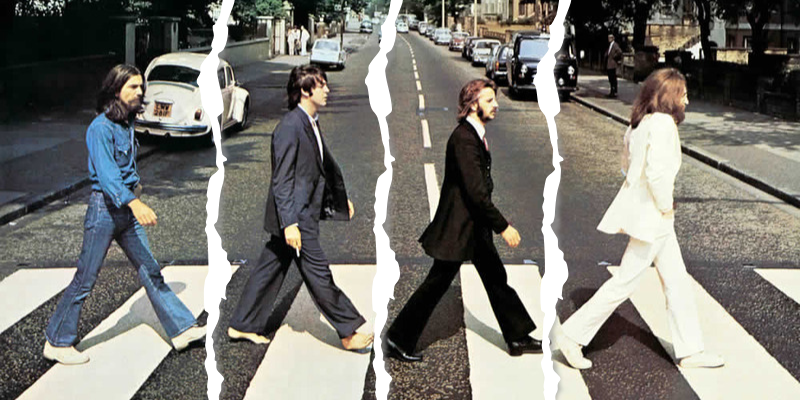
Lennon and McCartney fell out over several interconnected issues, but Allan Kozinn identifies the management battle surrounding Allen Klein as the central conflict. Their creative differences were real, but disagreements over control of Apple Corps, McCartney’s opposition to Klein and the eventual dissolution of the Beatles’ partnership turned those tensions into a lasting rupture.
What ended the Lennon-McCartney songwriting partnership?
The breakup of The Beatles unfolded gradually rather than as a single dramatic break. By the late 1960s, McCartney and Lennon were already writing in noticeably different styles, but still collaborating within the band. McCartney leaned toward structured melody and polished composition, while Lennon moved toward more direct, emotionally raw writing. These differences coexisted with continued collaboration and were not, on their own, the cause of the split.
The management battle over Allen Klein
The real fracture came through business. Apple Corps, the Beatles’ company founded in 1968, became unstable and poorly managed. The company, originally intended as a creative and commercial hub, quickly became disorganized, with projects launched without structure and finances poorly controlled.

By 1969, control of Apple Corps had become a major internal battle. John Lennon, George Harrison and Ringo Starr supported Allen Klein as the Beatles’ new business manager, while McCartney opposed Klein and backed Lee and John Eastman, his future father-in-law and brother-in-law. The dispute deepened the mistrust between Lennon and McCartney and widened the division within the group. As episode guest Allan Kozinn explained, “I think the battle between them really was mostly about Allen Klein.”
Lennon had already told the group he was leaving in September 1969, more than six months before McCartney publicly announced his own departure in April 1970. When McCartney made the split public, Lennon felt the story had been controlled in a way that added tension to an already fractured situation.

McCartney’s departure from The Beatles and lawsuit
In April 1970, McCartney announced his departure from The Beatles. On December 31 of that same year, he filed a lawsuit in the British High Court to dissolve the Beatles’ legal partnership. The court proceedings began in early 1971.Although framed as a business necessity, it was widely interpreted by the other members as a final rupture. The case became public and effectively formalized the end of The Beatles as a working entity.
The legal disputes continued for several years, but their most significant musical and emotional impacts occurred early. They reinforced the reality that McCartney and Lennon were no longer collaborators but separate forces moving in different directions.
Which Songs Were Part of the Lennon-McCartney Feud?
The Paul McCartney vs. John Lennon feud reached its most public stage through their solo recordings.
The clearest musical exchange consisted of McCartney’s “Too Many People,” Lennon’s much harsher response “How Do You Sleep?” and McCartney’s later reconciliation attempt “Dear Friend.” Other songs were interpreted as attacks, but not every perceived reference was intentionally directed at the other songwriter.
The clearest expression of the McCartney Lennon tension came through music between 1971 and 1972, when both artists used songs as direct responses to each other.
“Too Many People”: McCartney’s opening shot
Paul McCartney’s “Too Many People,” released in May 1971 on Ram, is widely considered the opening shot. Lyrics such as “Too many people preaching practices” and “You took your lucky break and broke it in two” were later acknowledged by McCartney as directed at Lennon. The tone is controlled but unmistakably pointed.
“How Do You Sleep?”: Lennon’s response
John Lennon responded with “How Do You Sleep?” on his September 1971 album Imagine. This is the most explicit and aggressive track in the entire post-Beatles exchange. Lines such as “The only thing you done was Yesterday” and “Those freaks was right when they said you was dead” directly attack McCartney. Lennon did not deny the song was written in response to McCartney’s perceived criticisms.
Former Beatle George Harrison joins Lennon on this song playing slide guitar, adding a double sting directed at their former bandmate. Another former bandmate Ringo Starr reportedly expressed discomfort during the sessions, warning Lennon that the lyrics risked being too harsh in its attacks on McCartney and suggested some of the ideas be dialed back.
"Dear Friend”: McCartney’s olive branch
A key emotional turning point came with McCartney’s “Dear Friend,” released in late 1971 on Wild Life with Wings. The song functions as an explicit attempt to reach Lennon, addressing emotional distance and offering reconciliation rather than criticism. Unlike earlier tracks, it contains no coded attacks and stands as a direct olive branch.
Other songs added to the perception of an ongoing musical exchange. McCartney’s “Dear Boy,” from Ram, was interpreted by Lennon as an attack, although McCartney later said that it concerned Linda and her former husband. Episode guest Allan Kozinn explained that Lennon perceived several lyrics on Ram as personal attacks, even when McCartney may not have intended them that way.
Lennon’s “Crippled Inside” and “Gimme Some Truth,” both released on Imagine, have also been associated with the feud. However, neither is generally considered a confirmed response to McCartney. In fact, “Gimme Some Truth” originated during the Beatles years. Their inclusion in the supposed musical battle demonstrates how listeners and the media began interpreting almost any confrontational lyric by Lennon or McCartney as another shot in their increasingly public feud.
The most direct songs formed a short, concentrated exchange conducted through records rather than conversation. Lennon also took the dispute beyond individual lyrics, publicly criticizing McCartney’s solo work and dismissing his former partner’s artistic direction. The conflict was therefore not merely something audiences imagined, even if the media interpreted more songs as attacks than either musician intended.
Did the Media Exaggerate the Lennon-McCartney Feud?

The media did not invent the Lennon-McCartney feud, but it helped exaggerate its duration and reduce both musicians to opposing cultural stereotypes. As episode guest Allan Kozinn observed, “Rolling Stone definitely did have a hand creating this idea that John was cool and Paul wasn’t.”

From the moment the Beatles’ breakup became public, music journalism played a major role in shaping how the Lennon-McCartney relationship was understood. Coverage during the early 1970s frequently emphasized conflict, presenting interviews and quotations in ways that highlighted disagreement rather than the pair’s shared history or continuing personal connection.

Publications such as Rolling Stone helped establish a cultural contrast that endured for years. Lennon was portrayed as "cool one", the politically engaged, edgy countercultural figure while McCartney was often presented as the more conventional, commercially oriented “square.” This simplified narrative influenced how audiences evaluated their solo careers and reinforced the perception of an ongoing rivalry even after their most serious personal and business disputes had subsided.
The media therefore helped transform a relatively brief period of intense hostility into a lasting “cold war” narrative that outlived the conflict itself.
When Did John Lennon and Paul McCartney Reconcile?
Lennon and McCartney began moving toward reconciliation after their musical attacks subsided. McCartney’s “Dear Friend” signalled his desire to end the conflict, while Lennon gradually withdrew from publicly criticizing his former songwriting partner. By 1973, the most intense phase of the Lennon-McCartney rivalry had largely ended.
The sharpest exchanges had occurred between 1971 and 1972. Their relationship was not immediately restored, but both men began stepping back from direct conflict and gradually reopened communication.
Their informal 1974 recording session
Surprisingly, Lennon and McCartney played together informally in Los Angeles on March 28, 1974. The loose jam session later circulated as the bootleg A Toot and a Snore in ’74. It was neither an official Beatles reunion nor a serious recording project, but it demonstrated that the two former partners could once again spend time together and make music without the hostility of the preceding years.

Reconnection and renewed friendship in the mid-1970s
Following the easing of tensions, Lennon and McCartney began reconnecting on a more personal level. They occasionally spent time together in New York, where Lennon was living, and their conversations increasingly concerned family, shared memories and everyday life rather than business disputes or the Beatles’ breakup.

McCartney later characterized these encounters as friendly and relatively normal, with much of the earlier tension gone. Their renewed friendship did not lead to a professional reunion: they never resumed their formal songwriting partnership or released new music together. Nevertheless, the hostility of the early 1970s had been replaced by familiarity, private contact and a genuine degree of reconciliation.
How Did the Lennon-McCartney Rivalry Influence Their Solo Music?
With their relationship improved, McCartney and Lennon continued their solo careers in parallel rather than opposition.McCartney through melody, Wings and commercial reach; Lennon through personal, political and introspective songwriting.
Paul McCartney found major success with Wings, formed in 1971. After early instability, the band became one of the most commercially successful acts of the decade. Band on the Run (1973) marked his defining post-Beatles album, featuring “Jet,” “Let Me Roll It,” and the title track “Band on the Run.” He followed with major hits including “Live and Let Die” (1973), “Silly Love Songs” (1976), and “Maybe I’m Amazed” (released as a single in 1977 though written earlier), reinforcing his reputation for melodic, accessible songwriting.
John Lennon’s solo path remained introspective and evolving. He released classic albums such as Imagine (1971), Mind Games (1973) and Walls and Bridges (1974) continuing his blend of personal reflection and broader commentary.
With the rivalry resolved, comparisons between them shifted from personal conflict to artistic contrast.
What Was the Lasting Impact of the Lennon-McCartney Feud?
The Lennon-McCartney feud lasted only a few years, but it shaped how audiences interpreted both men’s solo careers for decades. Their management dispute ended the working partnership, their musical exchange made the conflict public, and media coverage hardened an oversimplified contrast between “radical John” and “conventional Paul.” Their eventual reconciliation reveals a more complicated relationship: competitive and wounded, but also grounded in affection, shared history and mutual respect.
Check out: download our curated Paul McCartney & Wings playlists
© 2026 Garage To Stadiums Podcast