Face Paint and Fire: How Kiss Masculinized Glam Rock and Conquered America
- Scott Campbell
- Jun 15
- 6 min read
Updated: Jul 5

by Scott Campbell, Program Director
Garage to Stadiums Music History podcast
By the early 1970s, glam rock had a problem State-side. The music was electrifying, the spectacle was unlike anything audiences had seen before, and the artists behind it were some of the most gifted performers of their generation. But for a large swath of the American mainstream, glam rock came wrapped in something unsettling: androgyny. UK glam rockers wore satins, glitter, makeup and heels. For millions of rock fans, especially in the American heartland, the music was great but the look was a barrier they could not get past. Then came Kiss, and everything changed.

Kiss did not invent glam rock, and they were never exactly comfortable being called a glam band. But what they did was arguably more historically significant than anything their predecessors accomplished commercially. They took the core ingredients of glam, the theatrical costumes, the heavy makeup, the larger-than-life stage personas, and rebuilt the formula around an entirely different vision of masculinity. The result was a band that opened the door to an audience that had kept glam at arm's length, and in doing so, built a bridge from the glitter of the early 70s to the arena rock and hair metal that would dominate the following decade.


Kiss biographer Martin Popoff, author of KISS at 50 and KISS '76: Twelve Months in that Defined the Hottest Band in the Land was recently Dave Anthony's guest on the Garage to Stadiums music history podcast. He referred to Kiss as the "Oakland Raiders of glam rock", referring to the outlaw, tough as nails, bad boy image of the NFL team and how the band carried themselves with a similar swagger while under the glam rock spotlight.
Glam's Androgyny Problem in America
How British Glam Failed to Cross the Atlantic in the 1970s
To understand what Kiss accomplished, it helps to understand the cultural landscape glam rock was navigating. In Britain, where the movement largely originated, androgyny in rock had a context. Bowie's Ziggy Stardust persona landed in 1972 as an art statement in a country with a long tradition of theatrical gender play.
Marc Bolan of T. Rex was draped in feather boas and eye shadow, and British audiences largely embraced it as part of the rock spectacle. Roxy Music brought a sleek, almost cinematic glamour that was sophisticated and, by any measure, effeminate.

The New York Dolls and the Limits of American Glam
When glam crossed the Atlantic, the reception was more complicated. The New York Dolls, who emerged from the Manhattan club scene in 1972, translated the British template faithfully, perhaps too faithfully for the American market. They were brilliant and chaotic and deeply influential, but they never broke through to a mass audience. Their look - platform heels and women's clothing worn without irony - proved too alienating for rock fans outside of major coastal cities. Glam in America remained a cult phenomenon, beloved by those in the know and viewed with suspicion by everyone else.
Enter Kiss: The Demon, the Starchild, and the American Arena
Comic Books, Horror, and a New Vision of Rock Masculinity
Kiss formed in New York City in 1973 and drew from the same well as everyone else in their orbit. They loved the Who, they studied Alice Cooper, and they understood intuitively that rock and roll needed to be an event, not just a concert. But where their contemporaries leaned into ambiguity, Kiss leaned hard in the opposite direction.

The four personas they created, Gene Simmons as the Demon, Paul Stanley as the Starchild, Ace Frehley as the Spaceman, and Peter Criss as the Catman, came not from fashion or gender politics but from comic books, horror movies, and science fiction. These were the aesthetic references of teenage boys in the American suburbs. The makeup was heavy, yes, but it was menacing rather than feminine. Simmons breathed fire and spit fake blood. The band detonated explosions and flew above the crowd on wires. Whatever you thought of their image, there was nothing soft about it.
The Alice Cooper Influence and the Kiss Difference
Alice Cooper had pioneered this approach before them, blending theatrical horror with hard rock in a way that felt aggressive rather than delicate. Kiss acknowledged Cooper as a key influence, and it showed. They even brought in Cooper's producer Bob Ezrin. But where Cooper's act centered on one outsized personality, Kiss spread that intensity across four characters, each with a distinct identity that fans could latch onto. They industrialized the concept, and they aimed it squarely at the kid who had dismissed Bowie as too weird.
The Merchandising Machine
From Blood-Ink Comics to the Kiss Army: Building a Rock Franchise
The argument for Kiss's cultural significance does not rest on the music alone. It rests equally on what they built around the music, a merchandise empire that had no real precedent in rock history except perhaps the Beatles at the height of Beatlemania.

Beatles merchandise in the 1960s, the lunchboxes, the wigs, the trading cards, represented a new understanding of what a popular music act could be as a commercial brand. Kiss picked up that idea and pushed it further than anyone had imagined. By the late 70s, you could buy Kiss comic books with a genuine gimmick: the members reportedly donated their own blood to be mixed into the red ink. You could play a Kiss pinball machine, wear Kiss makeup kits, or watch Kiss Meets the Phantom of the Park, a made-for-TV movie. Four solo albums by the individual members were released simultaneously in 1978, a logistical and commercial stunt no band had attempted before. Every Halloween in North America meant a not insignificant amount of neighbourhood kids would knock on doors dressed as one of their fave Kiss characters.

This was not accidental. Gene Simmons and Paul Stanley were unusually shrewd businessmen for rock musicians of their era. Kiss was not just a band; it was a franchise. The merchandise was a core part of the strategy, selling an identity that fans could inhabit, with products as the physical tokens of membership. This literally manifested into thousands of enlisted fans who paid a subscription, known as the "KISS Army", which acted as a direct marketing channel to scale the money-making merchandise machine.
The Bridge to What Came Next
How Kiss Created the Template for Hair Metal and Arena Rock
The legacy of all this became clear in the 1980s. Hair metal, the dominant rock genre of that decade, was essentially Kiss's blueprint refined for MTV. Motley Crue, Poison, Twisted Sister: these acts were theatrical, heavily styled, and utterly comfortable with spectacle, but they presented it through a lens of strutting bravado that owed everything to the template Kiss had established. The art-school androgyny of Bowie and Bolan did not produce hair metal. Kiss did.
Glam rock in its original British form was always destined to be a minority taste in America. It was too comfortable with ambiguity, too rooted in a cultural moment that did not fully translate across the Atlantic. Kiss solved that problem not by abandoning glam's essential spirit but by rerouting it through references that resonated with a much larger audience. They took the costume, the theater, and the sheer excess of it all, and made it feel like something a 14-year-old in the midwest could call his own.
That is a remarkable thing to have done, and it deserves more credit than it typically receives. But the influence did not stop with the bands that followed in their musical wake. It extended to the very shape of live performance itself.
Kiss may have spawned the Modern Stadium Show
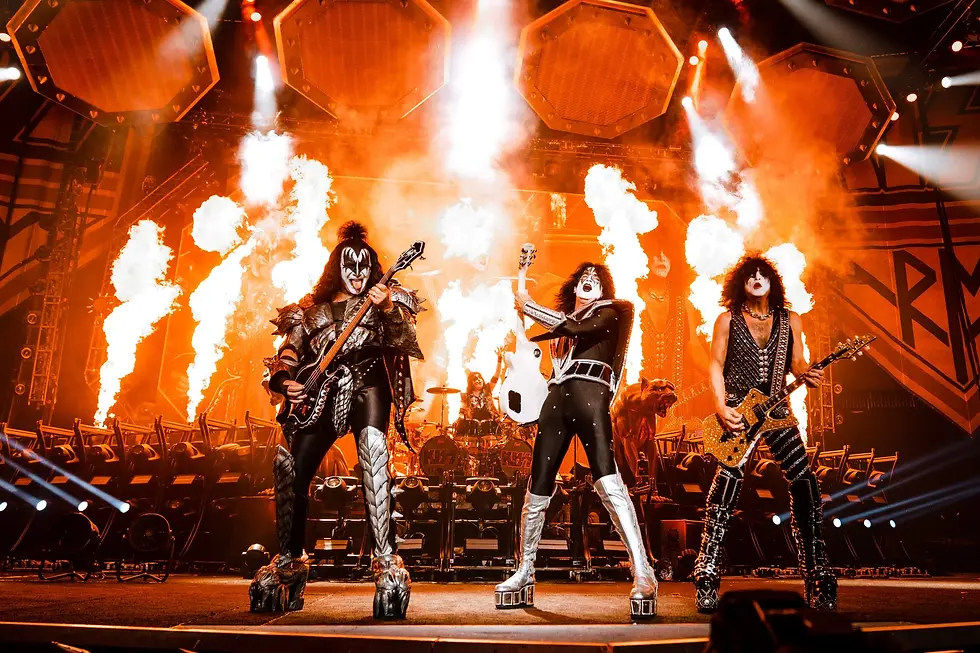
Kiss essentially wrote the rulebook for what an audience should expect from a night out. The smoke, the fire, the pyrotechnics, the sheer engineered scale of it all: these became the standard currency of arena entertainment, and Kiss spent it first. What began as rock and roll shock theater was gradually absorbed into the broader world of live performance across the musical spectrum. From Led Zeppelin to Madonna, from Britney Spears to Taylor Swift, the expectation that a major stage show must overwhelm the senses as much as it satisfies the ears traces a direct line back to those early Kiss concerts. Rock, pop, and everything in between has been staging Kiss shows ever since — most of them just don't know it.
Conclusion: Kiss was a bridge to the future for modern rock audience expectations
KISS took the theatrical DNA of British glam rock - larger-than-life characters, costumes, makeup, and stage spectacle - and repackaged it for a more mainstream American audience. They stripped away much of glam's gender ambiguity and replaced it with a harder, more overtly masculine image that resonated with Middle America. Just as importantly, they transformed the concert stage itself into an extension of that persona, unleashing smoke, fire, explosions, and dazzling lights on a scale rock audiences had rarely seen. In doing so, KISS helped redefine what a rock show could be, proving that music, character, and spectacle could merge into a single larger-than-life entertainment experience.
@2026 Garage to Stadiums Music History podcast